The Clinton School Impact Center is led by a team of dedicated researchers and evaluators with impactful, real-world experience. Our experts partner with public service organizations, nonprofits, government agencies, and businesses to provide the data-driven insights needed to measure impact and results, make informed decisions, and create lasting change.
Impact Center Leadership
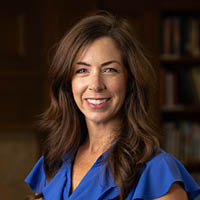
Dr. Nichola Driver
Assistant Dean of Impact | Executive Director of the Office of Field Servicenddriver@clintonschool.uasys.edu501-683-5215Dr. Nichola Driver serves as the Assistant Dean of Impact, Executive Director of the Office of Field Service, and an Associate Professor at the Clinton School of Public Service. She oversees two of the Clinton School’s signature field service experiences – the Practicum and the International Public Service Project (IPSP) – and teaches Field Research Methods.
Her research focuses on health disparities and the social determinants of health, with a particular emphasis on maternal and reproductive well-being. Her recent projects have investigated the impact of social support for new mothers, factors associated with food insecurity among Latino families, and the effects of group prenatal care on birth outcomes. As a native Arkansan, her scholarship is deeply committed to driving positive change within her home state.
A trained and experienced evaluator, Dr. Driver also leads the Clinton School Impact Center, which provides applied research and evaluation consulting for local, state, and international organizations. She has partnered with the Winthrop Rockefeller Foundation, Tempus Realty Partners, Bridge2Rwanda, Arkansas Department of Health, Entergy, Arkansas Human Development Corporation, UAMS Women’s Center, and Northwest Arkansas Community College, among others. She frequently serves as an invited speaker on the topics of monitoring and evaluation, developing indicators that matter, and the importance of logic models in program planning and evaluation.
Professionally, she is active in the American Evaluation Association, the Population Association of America, and the Southwestern Social Science Association. She also serves as a reviewer for journals such as the International Journal of Public Health and Journal of Child & Family Studies.
Dr. Driver holds a Ph.D. in Sociology from the University of North Texas and a Master of Public Administration from UA Little Rock. She formerly served as the Director of Nonprofit Leadership Studies at UA Little Rock.
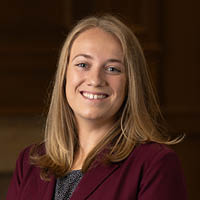
Katie George
Research & Evaluation Managerkgeorge@clintonschool.uasys.edu501-683-5656Katie George serves as the Research and Evaluation Manager for the Clinton School Impact Center, where she leads multidisciplinary initiatives providing applied research and evaluation consulting to nonprofits and government agencies.
Originally from Pittsfield, Maine, George holds a bachelor’s degree in psychology from Colby College and a Master of Public Service degree from the Clinton School of Public Service. A researcher and evaluator specializing in public health and impact evaluation, George discovered her passion for community-based methods during her time at the Clinton School.
Her work has had a tangible local impact, including the design of an evaluation plan for a peer-to-peer mental health resource for teens in the Arkansas Delta, a program set for implementation across Jefferson County schools. Her international expertise includes evaluating maternal mental health support programs in Peru and working as a Research Consultant for the Arkansas Rural Health Partnership.
Prior to her work at the Impact Center, George built an extensive background in public health and advocacy. She served with the Peace Corps in Malawi as a Health Educator, designing and implementing programs related to WASH, malaria, HIV, and nutrition. Her experience also includes service with AmeriCorps in Florida and work as an Advocate at a domestic violence shelter in Maine, where she focused on enhancing healthcare resources for survivors.

Tarryn Harris
Research Associatetharris@clintonschool.uasys.edu501-683-5214As a Research Associate, Tarryn Harris supports the Impact Center’s mission of providing data-driven solutions and strategic evaluation for public, private, and nonprofit organizations. She contributes to program evaluation, project management, and the development of evidence-based frameworks designed to address complex challenges.
A 2026 Master of Public Service graduate of the Clinton School, Harris is currently leading a wide range of research projects focused on public health prevention, workforce development needs assessments, and community-level interventions for families impacted by the opioid crisis.

Tiffany Jacob
Research and Program Specialisttljacob@clintonschool.uasys.eduTiffany Jacob is the Research and Program Specialist for the Clinton School Impact Center, where she is responsible for managing data collection and analysis on key projects, bringing specialized expertise to impact evaluation. A 2015 alumna of the Master of Public Service program, Jacob returned to the Clinton School in 2016 to lead international education programs within the Office of Field Service as the former Director of International Programs. Her leadership was instrumental in the Clinton School receiving the 2025 Senator Paul Simon Award for Campus Internationalization from NAFSA, a prestigious national honor recognizing excellence in international education.
Her career is rooted in a lifelong commitment to public service. Her professional journey includes roles in admissions, alumni relations, and career services at the Middlebury Institute of International Studies at Monterey as well as impactful positions with KaBOOM!, Rebuilding Together, Volunteer Iowa, and AmeriCorps. Locally, she has served as a Youth Master Plan Specialist for the City of Little Rock’s Department of Community Programs.
Jacob holds bachelor’s degrees in English and Scandinavian Studies from the University of Wisconsin-Madison and a Certificate in Career Development Facilitation from the National Career Development Association.