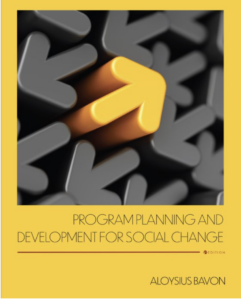
Dr. Al Bavon, Professor of Public Administration, has released his latest textbook, “Program Planning and Development for Social Change,” a comprehensive resource developed from decades of field experience and teaching at the Clinton School of Public Service.
Published earlier this year, the textbook serves as a “one-stop shop” for students and practitioners looking to translate academic theory into meaningful community impact. Bavon, who has taught program planning for 17 years, noted that the Clinton School’s unique focus on providing comprehensive field service for students was the primary catalyst for the project.
“This book is a reflection of the Clinton School experience,” Bavon said. “I’ve distilled years of teaching and our signature focus on field service into a concise resource that brings all of our best program planning tools together in one place.”
A Strategic Guide for the Public Service Workforce
While designed for the classroom, the textbook offers immediate value for nonprofit leaders and professionals in the workforce. It emphasizes a coordinated, theory-based approach to crafting purposeful activities, guiding readers through a step-by-step process that covers needs assessments, formulating SMART objectives, and choosing evidence-based models.
For practitioners, the book serves as a roadmap to avoid common pitfalls. It draws on broader literature and practitioner experiences to provide the requisite tools needed for successful program planning, development, evaluation, and long-term growth.
“Whether a leader is working in health, education, or environmental mitigation, the framework is designed to be applicable across any sector where there is a need to address problems with evidence-based solutions,” Bavon said.
Integrating Student Research and Faculty Expertise
A standout feature of the textbook is the incorporation of real-world contributions from Clinton School graduates. Bavon emphasized that his students were essential to the book’s development, providing insights into which topics needed more clarity or depth.
“I owe the students a lot,” Bavon said. “They have helped me out over the years in knowing what needed to be included. I dedicated this textbook to the students more than anybody.”
The text features work from Lydia Adusei, a 2023 graduate, who contributed a section on needs assessment and best practices. Another student provided a key chart used in the book. By incorporating these examples, the text bridges the gap between student learning and professional application.
Dr. Andreas Sihotang, Assistant Professor at the Clinton School, has already integrated the text into his Master of Public Service courses.
“I think Dr. Bavon’s book provides practical, easy-to-follow guidance for program planning,” Sihotang said. “The book offers concrete tips and examples on conducting needs assessments, setting goals and SMART objectives, identifying best practices, developing logic models and theories of change, and planning for performance measurement and program evaluation. Overall, it serves as a clear and practical foundation for applied program planning. Students found the text approachable and easier to absorb.”
Making an Impact in Arkansas and Beyond
With Bavon’s extensive international experience, he said that the program planning concepts learned from the textbook can be utilized as effectively in a local Arkansas nonprofit as they can be at an international organization. Bavon has already seen the framework put to use by practitioners in Ghana to support youth programs in Accra.
Ultimately, Bavon hopes the book leaves a lasting legacy of helping organizations make a difference in the lives of others through successful program planning.
“At some point in your life, you want to feel like you left the world in a better place,” Bavon said. “This book makes me feel like I’ve accomplished something I can be proud of, and the Clinton School helped me do that.”